Friends – or enemies?

Two friends were involved in a misunderstanding, which lead to one being brutally beaten by the other who had failed to recognise him. It is doubtful they remained friends. . .

“Last Tuesday evening, Mr. Feakins of Easondine, intending to pay a visit to a female acquaintance at Tollthorpe in the county of Rutland, went to the place of her residence, but not finding her at home, imagined she was gone to Mr. Goodwin’s, a miller, at the same place; he therefore went to learn whether she was there or not. – Unfortunately for Mr. Feakins, he was perceived by one of the servants, who informed Mr. Goodwin that a person had been looking in at the window. – Some villains having a short time before attempted to break into his house, he immediately order’d his gun, and followed Mr. Feakins, fired at him, shattered his hand in a most miserable manner, and then struck him a violent blow on the wounded arm with the butt end of his piece, before he knew his person. – Mr. Feakins is in a very dangerous state, a mortification being apprehended; and his arm is necessarily order’d to be cut off. – What renders this misfortune the more distressing to the parties, Mr. Feakins and Mr. Goodwin were intimate acquaintance, and very good friends.”

The Stamford Mercury, 22nd December, 1774.

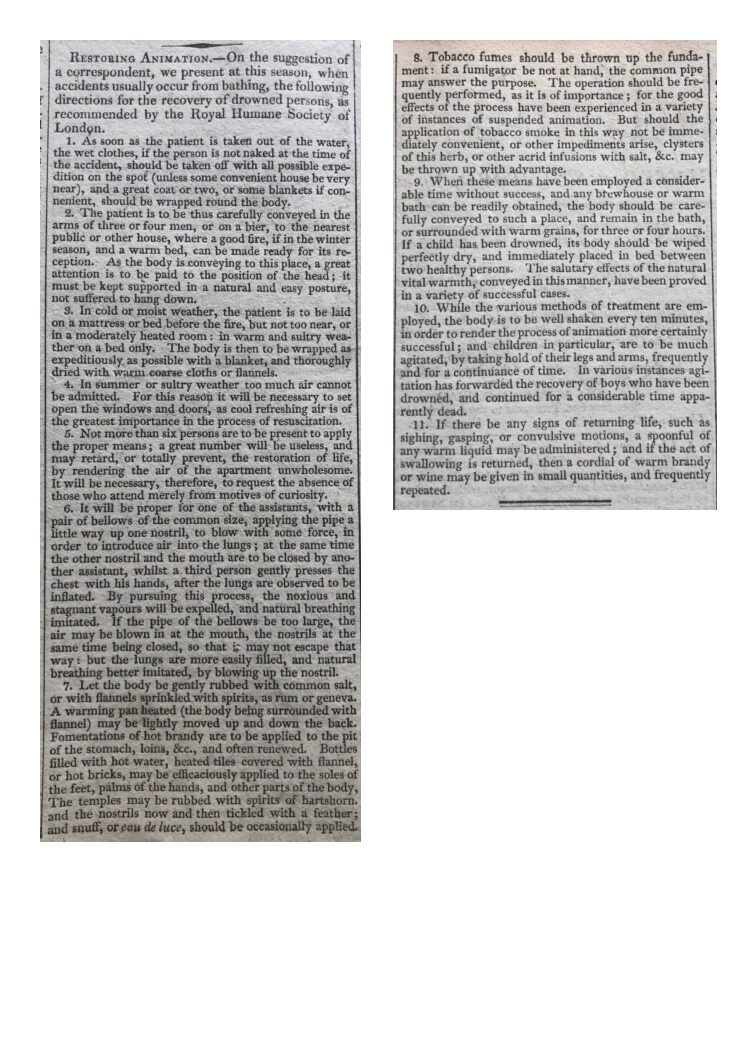
Restoring Animation

The procedure set out to ‘restore animation’, albeit it specific and detailed, would, we think, have taken rather too long to administer. Or course, we know now that the important thing is to give CPR as soon as possible.

“RESTORING ANIMATION. – On the suggestion of a correspondent, we present at this season, which accidents usually occur from bathing, the following directions for the recovery of drowned persons, as recommended by the Royal Humane Society of London.

  1. As soon as the patient is taken out of the water, the wet clothes, if the person is not naked at the time of the accident, should be taken off with all possible expedition on the spot (unless some convenient house be very near), and a great coat or two, or some blankets if convenient, should be wrapped round the body.
  2. The patient is to be thus carefully conveyed in the arms of three or four men, or on a bier, to the nearest public or other house, where a good fire, if in the winter season, and a warm bed, can be made ready for its reception. As the body is conveying to this place, a great attention is to be paid to the position of the head; it must be kept supported in a natural and easy posture, not suffered to hang down.
  3. In cold or moist weather, the patient is to be laid on a mattress or bed before the fire, but not too near, or in a moderately heated room: in warm and sultry weather on a bed only. The body is then to be wrapped as expeditiously as possible with a blanket, and thoroughly dried with warm coarse cloths or flannels.
  4. In summer or sultry weather too much air cannot be admitted. For this reason it will be necessary to set open the windows and doors, as cool refreshing air is of the greatest importance in the process of resuscitation.
  5. Not more than six persons are to be present to apply the proper means; a great number will be useless, and may retard, or totally prevent, the restoration of life, by rendering the air of the partment unwholesome. It will be necessary, therefore, to request the absence of those who attend merely from motives of curiosity.
  6. It will be proper for one of the attendants, with a pair of bellows of the common size, applying the pipe a little way up one nostril, to blow with some force, in order to introduce air into the lungs; at the same time the other nostril and the mouth are to be closed by another assistant, whilst a third person gently presses the chest with his hands, after the lungs are observed to be inflated. By pursuing this process, the noxious and stagnant vapours will be expelled, and natural breathing imitated. If the pipe of the bellows be too large, the air may be blown in at the mouth, the nostrils at the same time being closed, so that it may not escape that way: but the lungs are more easily filled, and natural breathing better imitated, but blowing up the nostril.
  7. Let the body be gently rubbed with common salt, or with flannels sprinkled with spirits, as rum or geneva. A warming pan heated (the body being surrounded with flannel) may be lightly moved up and down the back. Fomentations of hot brandy are to be applied to the pit of the stomach, loins, &c., and often renewed. Bottles filled with hot water, heated tiles covered with flannel or hot bricks, may be efficaciously applied to the soles of the feet, palms of the hands, and other parts of the body, The temples may be rubbed with spirits of hartshorn. and the nostrils now and then tickled with a feather; and snuff, or eau de luce*, should be occasionally applied.
  8. Tobacco fumes should be thrown up the fundament: if a fumigator be not at hand, the common pipe may answer the purpose. The operation should be frequently performed, as it is of importance; for the good effects of the process have been experienced in a variety of instances of suspended animation. But should the application of tobacco smoke in this way not be immediately convenient, or other impediments arise, clysters of this herb, or other acrid infusions with salt, &c. may be thrown up with advantage.
  9. When these means have been employed a considerable time without success, and any brewhouse or warm bath can be radily obtained, the body should be carefully conveyed to such a place, and remain in the bath, or surrounded with warm grains, for three or four hours. If a child has been drowned, its body should be wiped perfectly dry, and immediately placed in bed between two healthy persons. The salutary effects of the natural vital warmth, conveyed in this manner, have been proved in a variety of successful cases.
  10. While the various methods of treatment are employed, the body is to be well shaken evey ten minutes, in order to render the process of animation more certainly successful; and children in particular, are to be much agitated, by taking hold of their legs and arms, frequently and for a continuance of time. In various instances agitation has forwarded the recovery of boys who have been drowned, and continued for a considerable time apparently dead.
  11. If there be any signs of returning life, such as sighing, gasping, or convulsive motions, a spoonful of any warm liquid may be administered; and if the act of swallowing is returned, then a cordial of warm brandy or wine may be given in small quantities, and frequently repeated.”

The Stamford Mercury, 22nd June, 1821.

*volatile liquid soap, with a strong pungent smell.

As Dog ‘s my Witness

A pug dog was deemed to be an interested witness in this case. He was able to give vocal and physical evidence of the identity of his owner.

COURT of KING’S BENCH, Nov. 30.

Grammont v. Boyton. – This was an action of trover*. The defendant was charged with the conversion# of a pug dog. – Mr. Marryat, who opened the plaintiff’s case, proposed to support it by at least a dozen witnesses. The defendant admitted the taking of the dog, but alleged that he took him in the way of recovery: he confessed that he had found the dog when lost by the plaintiff, but affirmed that he had himself originally lost the dog, and that it was through such loss that the dog had first come into the plaintiff’s possession.

The Lord Chief Justice doubted whether the cause would not be better taken out of Court. The evidence of the dog himself would probably be necessary.

Mr. Gurney, had no objection to that course. The dog, indeed, was his leading witness.

Mr. Marryat begged to deny that fact: the dog was his witness – subpoenaed indeed by him.

Mr. Gurney, in that case, would insist upon cross-examining him.

Mr. Marryat was ready to refer the cause, but the dog would appear most clearly to belong to the plaintiff. In fact, he had already escaped once or twice from the defendant, and had made his way to his rightful owner.

Mr. Comyn took the dog to be an interested witness. It was doubtful how far his evidence would be admissible.

Mr. Gurney was ready to give him a release.

Mr. Marryat – Now you know that you keep him always tied up: if he were released, he would be with us in a moment.

Here the prisoner (the dog) from the lower end of the hall, testified viva voce to the truth of Mr. Marryat’s assertion.

The Lord Chief Justice said that the dog would give his evidence far more collectedly in a prrivate room, before some gentlemen of the bar, Such gentlemen might have more acquaintance with dogs than he (the Lord Chief Justice) could pretend to.

Mr. Gurney was of the same opinion, but his clients demurred.

The Lord Chief Justice was sorry fo it. There was somethjing inconsistent with the decorum of a Court in having such a witness as a dog produced.

Mr. Marryat said that his client was afraid lest the arbitrator might award damages instead of the dog. Nothing could compensate the loss of the animal.

The Lord Chief Justice said that the plaintiff might be ensured: let the arbitrator (to either party) award the dog and nominal damages.

The parties then agreed to refer,

The Stamford Mercury, 7th December, 1821.

*Trover – A law action to recover the value of chattels or goods.

#Conversion – Taking with intent of exercising ownership over a chattel.

Violent Storm Struck

A violent storm struck in the local area resulting in damages, costly repairs with broken panes and looking-glasses.

“On Sunday last, a quarter before two P.M the greatest storm visited this place ever occurred in the memory of it’s eldest inhabitant. The awful grandeur of the elements previous to it’s breaking forth no one could contemplate without being forcibly struck with the Psalmist’s sublimity, wherein he describes the omnipotent as riding on the whirlwind and directing the storm. Incellant lightning, continued thunder, the clouds intersecting each other in an extraordinary manner, excessive sulphorous heat attended by darkness (at which time a thermometer in the west aspect stood at 75, and fell before two o’clock to 60 degrees) preceded a violent tempest of hail and wind from the south west, which continued for about 20 minutes, and fearcely left a window whole in the town facing south or west; many had all the panes broke, and in some instances whole lights were drove in by hail stones, several of which measured five inches in circumference and weighed more than an ounce. It is supposed that 1,200l. will not pay the damages done in this place only.

We understood the above storm extended about six miles in width; was equally violent in it’s effects at Kettering and neighbourhood, where Boughton-house alone has received damage to the amount of 300l. From thence our readers may trace it’s direction by remarking the dreadful ravages at Dean, the seat of Lord Cardigan; Lord Carberry’s at Laxton, where fearce a pane was left whole in front of the hall, in which it broke several looking-glasses; tore up trees, and killed a cow;-at Fineshade, the Hon.J. Monckton’s; Kirby, the Hon. Finch Hatton’s; Bulwick, Blatherwick, Harringworth, Wakerley, Barrowden, Duddington, Collyweston, Easron, Ketton, Tickencote, the two Castertons, and as far as the 84th milestone on the north road, which appears to have been it’s boundary that way. Ryal, Witham-o’-th’-Hill, Grimsthorpe, where the Duke of Ancaster’s cattle is much injured; Bourn;-here it’s ravages are shocking, it being computed that 700l. will not repair the damage done to the houses alone; Sleaford also sustained considerable injury.”

The Stamford Mercury 9 May, 1800.

Cramping Women’s Feet

The Imperial Chinese practice of cramping the feet of young girls to keep them small died out in the early 20th century, but was it any worse that other nations’ customs such as tattooing, or compression of the waist for the sake of fashion?

“The most unaccountable species of taste is that mutilation of the women’s feet, for which the Chinese are so remarkable.  Of the origin of this custom there is no very distinct account, except that it took place about the close of the Tang dynasty, or the end of the ninth century of our era.  The Tartare have had the good sense not to adopt this artificial deformity, and their ladies wear a shoe like that of the men, except that is has a white sole of still greater thickness.  As it would seem next to impossible to refer to any notions of physical beauty, however arbitrary, such shocking mutilation as that produced by the cramping of the foot in early childhood, it may be partly ascribed to the principle which dictates the fashion of long nails.  The idea conveyed by these is exemption from labour;  and, as small feet make cripples of women, it is fair to conclude that the idea of gentility which they convey arises from a similar association.  That appearance of helplessness which is induced by the mutilation, they admire extremely, notwithstanding its very unusual concomitant of sickliness; and the tottering gait of the poor women, as they hobble along upon the heel of the foot, they compare to the waving of a willow agitated by the breeze.   We may add that this odious custom extends lower down in the scale of society than might have been expected from its disabling effect upon those who have to labour for their subsistence.  If the custom was first imposed by the tyranny of the men, the women are fully revenged in the diminution of their charms and domestic usefulness.  In no instances have the folly and childishness of a large portion of mankind been more strikingly displayed than in those various, and occasionally very opposite, modes in which they have departed from the standard of nature, and sought distinction even in deformity.  Thus, while one race of people crushed the feet of its children, another flattens their heads between two boards; and while we in Europe admire the natural whiteness of the teeth, the Malays file off the enamel and dye them black, all for the all-sufficient reason that dogs’ teeth are white!  A New Zealand chief has his distinctive cost of arms emblazoned on the skin of his face, as well as his limbs; and an Esquimaux is nothing if he have not bits of stone stuffed through a hole in his cheek.  Quite as absurd, and still more mischievous, is the infatuation which, among some Europeans, attached beauty to that modification of the human figure which, resembles the wasp, and compresses the waist until the very ribs have been distorted, and the functions of the vital organs irreparably disordered. – Davis’s Chinese.”

The Stamford Mercury, 28th August, 1840

Extraordinary Anecdote of a Dog.

Almost as extraordinary as Greyfriars Bobby, the level of canine loyalty of Crib, from The Red Lion at Cambridge, was touching.

“– Many marvels have been narrated concerning the dog and his attachment to man, but we know not that we ever heard of anything more extraordinary than that which we are about to tell our readers.  At the Red Lion hotel in Cambridge there is an old, one-eyed, worn-out dog of the terrier breed, named Crib.  He lies about in the yard, or stable, or kitchen, and enjoys his otium cum dignitate* just as is most agreeable to himself and consonant with his age and infirmities.  Possessed of a proper sense of his own merits and position, he is somewhat particular as to the company he keeps, and one of the few persons admitted to his friendship was the late lamented John R. Barker, Esq., who was kind to the old animal, as he was to every body and every thing, and took a great deal of notice of ‘poor old Cribby’.  For some two years past Crib has probably not been a hundred yards from the Lion gateway; indeed, as we understand, he would not follow any of the servants or handers-on off the premises.  Now, Tuesday the 17th inst. Was the day appointed for the funeral of Mr. Barker, and the hearse used on the melancholy occasion belonged to Mr. Mitchell, and consequently proceeded from the Lion yard.  Strange and unaccountable as it may seem, it is nevertheless true that this superannuated dog, which had scarcely been off the premises for two years, and which never by any sort of accident followed any of the post-boys or other servants, accompanied the hearse to Mr. Barker’s late residence, sat opposite the door until the body was placed within it, walked by the side of the mournful procession to Little St. Mary’s church, remained opposite thereto until the remains of his friend were consigned to their final place of rest, and then returned home unattended, the hearse having quitted the scene some time before!  We pretend not to offer any comment upon this extraordinary occurrence, but we assure our readers the facts are as we have stated them to be.” – Cambridge Chronicle.

*Leisure with dignity.

The Stamford Mercury, 27th January, 1843.

Arsenic Tragedy

A poisoner chose arsenic as his weapon to kill his wife, but sadly missed his target and killed his own child and a neighbour. His lawyer had objected to the second trial, on the grounds of double jeaopardy (or ‘autrefois acquit‘), but the Judge did not agree. Since the Criminal Justice Act 2003, double jeopardy has been permitted in England and Wales only in certain (exceptional) circumstances.

“A laborer at Hempnall, named Daynes, was tried on Friday at the Norfolk assizes for murdering his own child, by placing arsenic in the tea-kettle. His wife and another child narrowly escaped, and a woman names Mills died. He was acquitted, from the want of proof, and on the ground that he could have no motive to destroy his family. He was afterwards tried for murdering Mills, his intention being to poison his wife that he might marry a widow named Lloyd, with whom he had illicit intercourse: her evidence brought the crime home to him and he was found guilty. The Judge, in passing sentence, earnestly exhorted him not to indulge the faint hope of mercy. In the evening he made a full confession of his guilt; that he had for months meditated poisoning his wife with arsenic, which he purchased at Norwich, and had twice endeavoured ineffectually to carry his deadly purpose into execution, once by putting the poison in some fried potatoes, and afterwards in pea-soup, but both failed: his third attempt ended in the destruction of two against whom he had no enmity, whilst his intended victim again escaped. Mr. Taylor, for the prisoner, who had objected to the second trial on the ground of autrefois acquit, urged the stay of judgement until the opinion of the 15 Judges had been taken, but Mr. Justice Vaughan declined, adding, however, that he should meet all the Judges on Monday, and would mention the point to them, but he desired the matter should not be mentioned to the prisoner, that he might not calculate on an escape from execution.”

The Stamford Mercury, 19th April, 1839.

Coronation Celebrations

Having just experienced the procession and pomp of King Charles III’s coronation, it is interesting to find out how Stamford celebrated that of his great, great, great grandmother.

“The Queen’s coronation was celebrated yesterday in Stamford with the utmost loyalty, and with the happiest effect. One of the best and most numerous processions ever seen in the town was marshalled by 12 o’clock, when it started from the Town-hall, as follows:-

Two Trumpeters on Horseback – Two Policemen – Purple Flag (given by the Ladies for the occasion) – Tradesmen’s Loyal and Independent Society, with their respective colours and full accompaniments – Loyal and Independent Lodge of Odd Fellows, No. 6, with their respective colours and accompaniments – Boys of the different Charity and Sunday Schools, six abreast – White Flag – Girls of the different Chariy and Sunday Schools, six abreast – White Flag (given by the Ladies for the occasion) – Band – Military – Crier with Staff of Office – Beadle with Bill of Office – Sergeants at Mace (bearing Maces) – The Mayor and his Chaplain – Magistrates – Aldermen – Town Clerk – Town councillors – Clergy in their Gowns – Gentlemen and Inihabitants of the Town, six abreast.

In the delightful weather, amidst the music of the bank and the ringing of bells, the procession passed through all the principal streets of Stamford and St. Martin’s, occasionally halting to give cheers. The procession itself was half a mile long; and every where cheerful countenances indicated the satisfaction that was felt, and the sincereity with which all hailed the great occasion as one calculated to ensure and to perpetuate the liberties and the happiness of the nation. – About two o’clock, 1000 children of the different charity schools sat down to a dinner of roast beef and plum pudding, comfortably set out in the several stalls of the butchery, which were fitted up for the occasion: the scene was one of unalloyed enjoyment. In addition to this, 400 poor men and wqomen, 60 years of age, received each 1s. with which to regale themselves; and 1000 other poor men and women received tickets, entitling each to obtain at the public-houses sixpennyworth of beer. The gentry and tradesmen of the town dined in parties at the different inns, and the whole day passed off with the highest conviviality, and with uninterrupted satisfaction.”

The Stamford Mercury, 28th June, 1838.

Tatooed Convict

This tatooed convict would be easily recognizable if he were caught. His name appears on the Nottingham census in 1851, so maybe he wasn’t!

“A “MARKED” MAN. -The following minute and curious description of an escaped convict appears in the Police Gazette:- “William Mellors, a convict belonging to the Ganymede hulk at Woolwich, escaped on the 5th inst., while at labour in the dock-yard. He was convicted at Nottingham, on the 29th of June, 1838, of stealing a cock-fowl, and sentenced to seven years’ transportation; he has been in the house of correction, and in prison for felony. He is five feet four inches high, dark brown hair, grey eyes, full nose, common mouth, oval visage, stout made, dark complexion, 32 years of age; is single, can read and write, has a scar on the left eye, one on the top of his nose, sundry brawn blotches on the back, tatooed on the right arm – sun, moon, and seven stars, a woman with a skipping-rope and C.B., mermaid, a flower-pot with flowers, gun and carriage, stripe with three shots in it – rings on middle and fore fingers of right hand; tatooed left arm – a woman’s head, two pipes across, a foul anchor wrong side up, J.M., C.B., B.O.L.E.S. † A.N.N., a woman, MELLORS †, daughter O.F. W.M. † ;- rings on middle and fore fingers of left hand; a stag on breast-bone, a man with his hand in his pocket and a glass in his hand, a dog underneath, a woman with parasol and reticule, cat underneath, a gate on of the back, a dog on left side, and scar on right shin bone.”

The Stamford Mercury 16th November, 1838.

Chimney Sweeping

Extract from 3 and 4 Victoria, Cap. 85, being an Act for the regulation of Chimney Sweepers and Chinmneys:-

Chimney sweeps were using children as young as four to go up and clean chimneys or dislodge brushes which had become stuck. This Act was intended to bring an end to that practice, but it was not until a further Act in 1862, that the sweeps were finally stopped from using children at all (including their own).

And it being enacted that, from and after the 1st day of July in the year 1842, any person who shall complet of knowqingly allow any child ir young person under the age of 21 years to ascend or descend a chimney, or enter a flue, for the purpose of sweeping, cleaning, or coring the same, or for extinguishing fire therein, shall be liable to a penalty of not more than 10l. nor less than 5l.

That from and after the passing of this Act, it shall not be lawful to apprentice to any person ising the trade or business of a shimney-sweeper any child under the age of 16 years and that every indenture of such apprenticeship which may be entered into after such date shall be null and void.

That from and after the 1st day of July, 1842, all existing indentures of apprenticeship to the trade or business of a shimney-sweeper of any child who shall then be under the age of 16 years shall be null and void.

And whereas it is expedient, for the better security from accidents by fire or otherwise, the improved construction of chimnieys and flues provided by the said Act be cintinued; be it enacted, that all withs and partitrions between any chimney or flue which at any time after the passing of this Act shall be built or rebuilt shall be of brick or stone, an at least equal to half a brick in thickness; and every breast-back and with or partition of any chimney or flue hereafter to be built or rebuilt shall be built of sound materials, and the joints of the work well filled in with good mortar or cement, and rendered or stuccoed within; and also that any chimney or flue hereafter to be built or rebuilt in any wall, or of greater length than four feet out of the wall, not being a circular chimney or flue twelve inches in diameeter, shall be in every section of the same not less than 14 inches by 9 inches; and no chimney or flue shall be constructed with any angle thering which shall be less obtuse than an angle of 120 degrees, except as is hereinafter excepted; and every salient or projecting angle in any chimney or flue shall be rounded off four inches at least, upon pain of forfeiture, by every master-builder or other master0workman who shall make eor cause to be made such chimneyt or flue, of any sum not less that 10l. nor exceeding 50l. – Provided nevertheless, tha notwithstanding this Act chimenys or flues may be built at angles with each other of 90 degrees and more, such chimneys or flues having therein proper doors of openings not less than six inches square.

The Stamford Mercury, 18th February, 1842.