Mercuriosities

Burghley Bells

The bells rang out for Lord Burghley‘s birthday, but Stamford folk were not happy. His father, the (3rd) Marquis of Exeter was not a popular man in 1845 due to his opposition to the railway coming to the town.

“Nine-tenths of the inhabitants of Stamford were greatly annoyed at an early hour on Wednesday morning by the ringing of bells at several of the churches of the town. It was stated to be on account of its being the birthday of Lord Burghley (eldest son of the Marquis of Exeter), who on that day completed his 20th year. The ringing was continued throughout the day; and, connected with the exceeding unpopularity of the Marquis’ unscrupulous opposition to the railway which is to bring coals to the town at one-third of the price heretofore paid for them, and to confer other essential advantages on the inhabitants, made the annoyance intolerable at this juncture. Many, disturbed from their business by the din of the bells, assembled in the streets, and expressed their dissatisfaction in indignant terms, declaring that, with the experience they had, they could not find it in their hearts to rejoice, ‘for all Lord Exeter’s honesty, or all Lord Burghley’s beauty.'”

The Stamford Mercury, 7th February, 1845.

Chaise and Horses Tragedy.

Quite why this post-boy needed to hide his actions from Mr. Whincup of the George is not clear. Perhaps he had borrowed the chaise to deliver the passengers to Empingham on the quiet?! In any case, the chaise and all the horses were lost in the Welland.

It is also not clear what sort of vehicle it was, some were two-wheeled and driven by only one horse, others (like a post chaise) could be four-wheeled and enclosed. Often the driver would ride one of the horses.

“A serious loss was sustained by Mr. Whincup, of The George Inn in this place, on Wednesday night, through the misconduct of a post-boy names James Eaton. He had driven to Empingham two passengers who came to Stamford by the Regent coach, and on his return went with the chaise and horses into the river Welland, on the north side (to avoid observation from the George), to wash them, and the consequence was that the whole were by force of the current carried down the river. Opposite the brewery of Mr. Phillips the cries of the post-boy were heard, and that gentleman’s pleasure-boat was immediately used to save him: he was standing on the top of the chaise, with his head just above the water, when he was rescued: immediately the chaise and horses sunk, and the cattle* were drowned.”

The Stamford Mercury, 4th March, 1825.

*I don’t think there were cattle involved as well. Perhaps this refers to the horses?

The Robin of Lincoln Minster

Erithacus rubecula, or robin, our favourite garden bird took up residence in Lincoln Minster and everybody loved it, except an officious Verger.

“This bird (probably a pious decendant of the old visitor), which for so many winters has taken up its abode in the caythedral, has commenced its carolling rather early this season. On Sunday afternoon the 12th inst. it was seen flitting about the choir, sometimes perched in the carved work surmounting the Bishop’s throne, then flying off to the altar-screen, shirping a few short notes until the organ peeled forth the commencement of the psalms, when it warbled aloud in accompaniment of the chanting, and frequently after added its melody to the choruses, especially when the boys were singing; grateful probably for the scattered scumbs they bring to it, or finding the alto of their youthful voices more accordant with its own notes than the deeper tones of the tenor and bass. Robin is generally ‘residentiary’ during the winter season, and either from long practice or good teaching has learned to conduct itself very passably. The bird seldom does more than chirp a note ot two during the prayers or the lessons, but for this forbearance considers itself fully entitles to sing ad libitum whenever the choir organ gives the tone. Some years ago a surly verger endeavoured to shoot poor Robin, as an intruder and a nuisance, but all who love the Robin (and who does not) will rejoice to learn that, though carved work and glass sustained damage, the pious bird escaped.”

The Stamford Mercury, 17th October, 1845.

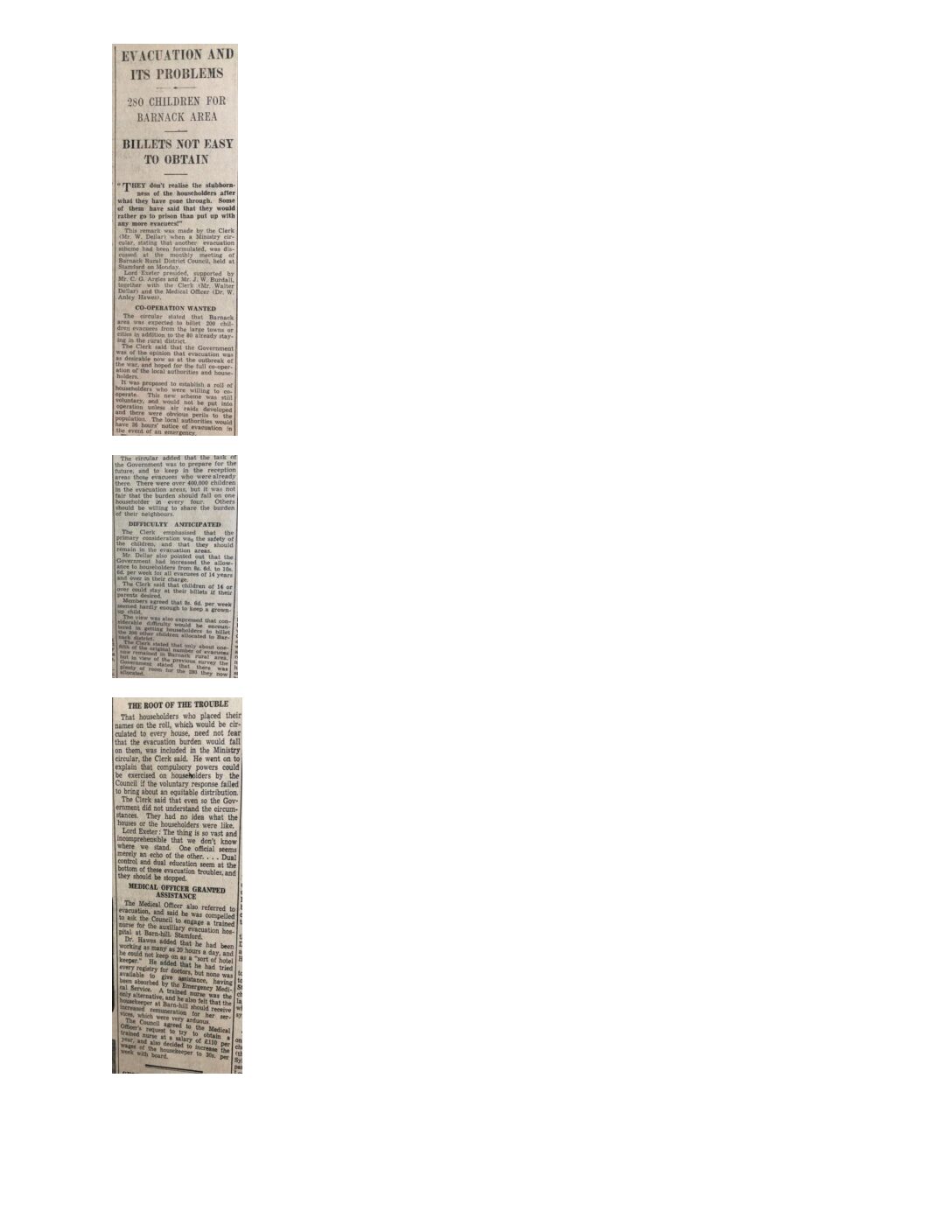
Evacuation and its Problems

Major evacuation (‘Operation Pied Piper’) began in September, 1939. By February 1940 the small village of Barnack had taken 80, but the Government wanted the villagers to take another 200!

“280 CHILDREN FOR BARNACK AREA

Billets not easy to obtain.

‘They don’t realise the stubborness of the householders after what they have gone through. Some of them have said that they would rather go to prison than put up with any more evacuees!’

This remark was made by the Clerk (Mr. W. Dellar) when a Ministry circular, stating that another evacuation scheme had been formulated, as discussed at the monthly meeting of Barnack Rural District Countil, held at Stamford on Monday.

Lord Exeter presided, supported by Mr. C. G. Argles and Mr. J. W. Burdell, together with the Clerk (Mr. Walter Dellar) and the Medical Officer (Dr. W. Anley Hawes).

CO-OPERATION WANTED

The circular stated that Barnack area was expected to billet 200 children evacuees from the large towns or cities in addition to the 80 already staying in the rural district.

The Clerk said that the Government was of the opinion that evacuation was as desirable now as at the outbreak of the war, and hoped for the full co-operation of the local authorities and householders.

It was proposed to establish a roll of householders who were willing to co-operate. This new scheme was still coluntary, and would not be put into operation unless air raids developed and there were obvious perils to the population. The local authorities would have 36 hours’ notice oif evacuation in the event of an emergency.

The circular added that the task of the Covernment was to prepare for the future. There were over 400,000 children in the evacuation areas, but it was not fair that the burden should fall on one householder in every fout. Others should be willing to share the budren of their neighbours.

DIFFICULTY ANTICIPATED

The Clerk emphasised that the primary consideration was the safety of the children, and that they should remain in the evacuation areas.

Mr. Dellar also pointed out that the Government had increased the allowance to householders from 8s. 6d. to 10s. 6d. per week for all evacuees of 14 years andover in their charge.

The Clerk said that children of 14 or over could stay at their billets if their parent desired.

Members agreed that 8s. 6d. per week seemed hardly enough to keep a grown-up child.

The view was also expressed that considerable difficulty would be encountered in getting householders to billet the 200 other children allocated to Barnack district.

The Clerk stated that only about one-fifth of the original number of evacuees now remained in Barnack rural area, but in view of the previous survey the Government stated that there was plenty of room for the 280 they now allocated.

THE ROOT OF THE TROUBLE

That householders who placed their names on the roll, which would be sirculated to every house, need not fear that the evacuation burden would fall on them, was included in the Ministry circular, the Clerk said. He went on to explain that compulsory powers could be exercised on householders by the Council if the voluntary response failed to bring about an equitable distribution.

The Clerk said that even so the Government did not understand the circumstances. They had no idea what the houses or the householders were like.

Lord Exeter : The thin is so vast and incomprehensible that we don’t know where we stand. One official seems merely an echo of the other . . . .Dual control and dual education seem at the bottom of these evacuation troubles, and they should be stopped.

MEDICAL OFFICER GRANTED ASSISTANCE

The Medical Officer also referred to evacuation, and said he was compelled to ask the Council to engage a trained nurse for the auxiliary evacuation hospital at Barn-hill, Stamford.

Dr. Hawes added that her had been wroking as many as 20 hours a day, and he could not keep on as a ‘sort of hotel keeper.’ he added that he had tried every registry for doctors, but none was available to give assistance, having been absorbed by the Emergency Medical Service. A trined nurse was the only alternative, and he also felt that the housekeeper at Barn-hill should receive increased remuneration for her servcies, which were very arduous.

The Council agreed to the Medical Officer’s request to try to obtain a trained nurse at a salary of £110 per year, and also decided to increase the wages of the housekeeper to 30s. per week with board.”

The Stamford Mercury, 23rd February, 1940.

Love Stories

Quite why these two love stories are reported in November is unclear. We always though it was in the spring that ‘young man’s fancy lightly turns to thoughts of love‘*. However, the village, first over the scottish border, became a haven for lovers following the 1754 Marriage Act (England and Wales). Youngsters under 21 were forbidden to marry without parental permission.

“During the last ten days, there have been several flights of ‘happy pairs’ through Carlisle, towards the shrine of Gretna. On the 3d inst. an old man from Askham, Westmoreland, (aged sixty,) flew thither on the wings of love, with a buxom damsel of twenty. And on the 5th inst. a more elevated couple drove northward in a chaise and four full gallop. Who they were, or whence they came, no one can tell: but, like the late Lord Erskine, the gentleman was veiled (if not petticoated) as he hurried through the town! – These are rare times for the brandy-loving noose-tyer. – Carlisle Journal.”

“A religious sect has recently spring up in the county of Surrey, one of whose tenets is to salute each other a meeting with a holy kiss. One of the female devlotees, a young lady of a thousand charms, happened to encounter a young gentleman, of whom she was enamoured, and gave him a more cordial and loving salute than was quite becoming. The next day she received a message from the High Priest of the sect, saying that she had been excommunicated for ‘kissing with an appetite’.”

The Stamford Mercury, 12th November, 1824.

*From Lockslely Hall, by Alfred, Lord Tennyson.

Awful Circumstance

We have all experienced the urge to jump, when standing next to a drop or abyss. In this story, Mr. A ‘s companion felt the same with tragic consequences.

‘Extract from a private letter to the Editor – “A brother of a respectable gentleman at Bristol (known for several branches of my family), was make a tour a short time since on the Continent for the benefit of his health. When travelling through Italy, he one day met with a young man who was pursuing the same course; and as he seemed without connections or attendants, and possessed interesting manners and a prepossessing appearance, Mr. A. propsed that they should continue their journey together. In the course of conversation, he discovered that the young man had deeply imbibed the principles of infidelity; and Mr. A. being a pious and intelligent man, entered upon the subject with the hope of imparting to his companion the comfort of those doctrines of which he himself felt the power and the value; and the young man listened with apparent attention and interest. On the following day they ascended to the summit of the burning Vesuvius, and contemplated its terrific crater with astonishment and awe. Next day the stranger requested Mr. A. to accompnay him again to the volcano; but he, finding himself exhausted by the fatigue of the journey, declined; promising, nevertheless, should his strength rally, that he would comply with the request on the morrow. For the morrow the young man waited not, – but hiring a guide, he proceeded immediately to the spot. At the summit he stood for some time, looking at the tremendous chasm; and then, presenting his watch to the attendant, he plunged headlong into the abyss! The guide, almost petrified at the sight, remained for a time in silent horror, and at length returned to the inn, to inform Mr. A. of the event, and to give into his hands the watch he had received for the deluded and unhappy creature. Mr. A., whoc was rapidly sinking in the last stage of consumption, was inexpressibly shocked; and after sending the account to his friends in England, in a short time he expired, under the consolatory and peaceful influence of those truths which led him to the joyful expectation of an inheritance in the skies!”‘

The Stamford Mercury, 12th November, 1824.

First Train to Peterboro’

A huge crowd of over 10,000 people descended on Peterboro’ to see the opening of the railway line to Blisworth.

“Opening of the Peterboro’ and Blisworth Railway – This line having been inspected by General Pasley, the Inspector-General of Railways, the formal opening took place on Saturday, the particulars of which will be found in our fourth page. Monday was appointed for the opening of the line to the public- an event which will be long remembered by the many thousands of persons who witnessed the proceedings of the day. The first up-train left Peterboro’ station (which is a capacious place on the east side of the London road a few hundred yards from the bridge) at 7 o’ clock in the morning, with six carriages, and another train followed at 1/2 past 10 with a goodly number of passengers; and this later met the first down-train from London at the Wansford station, where the latter arrived shortly before 12 (at least one hour after its appointed time). The passengers from London, Northampton, Wellingboro’, Higham Ferrers, Thrapston, Oundle &c., having filled the first train to Peterboro, the greatest disappointment was experienced at Sibson station, where at least 200 persons were waiting to proceed by it to Peterboro’: a few did succeed in getting upon the roofs of the carriages, but the more respectable company were left behind, and had their ticket-money returned. On this train’s approaching Peterboro’, a most interesting scene presented itself to the voyagers, many thousand persons having congregated to witness the arrival of the first public railway train into that city; and although the population was under 7000 at the taking of the last census, it is believed there must have been from 10,000 to 12,000 persons present – every town and vilage for some miles around having assisted to make this extradionary assemblage. The majority of the company occupied the meadow where the celebrated bridge-fair is held, but the bridge and the road thence to the turnpike were also densely crowded with anxious spectators, as also was every window from which a view of the train could be obtained: it was stopped on the west side of the road for the purpose of receiving the passengers’ tickets, which occupied about a quarter of an hour, and after this the road was crossed on the level, and the train approached the station, in Fletton parish, amidst the plaudits of the throng, the ringing of the church bells, and bands of music. The moving mass then crossed the river Nene and entered the city, at which time at least half the shops were closed, and those who were ready to wait upon their patrons seemed to have little or nothing to do. The inns generally were very crowded, and from the presence of so many strangers the landlords must have experienced a good harvest. The interval which took place between the arrival of the first train from London, and that of the second, which was advertised to arrive at a quarter to 3 o’clock, was occupied in taking refreshment, and in visiting the cathedral and the shows : the latter consisted of Ewing’s wax-work exhibition, a theatre, and several other attractions of less importance, which were stationed in the Market place.”

The Stamford Mercury, 6th June, 1845.

Tunnel under the Thames

The first sub-acqueous tunnel in the world went from Rotherhithe to Wapping, and was designed and built by Marc Brunel*. It was completed in 1843. Strangely, it is now part of the London Overground rail system.

“It is said that all the shares of this undertaking are filled up, and Parliament has given leave to bring in a bill to carry it into effect. The attempt, therefore, will once more be made in good earnest, under the direction of an engineer named Brunel *. The plan proposed in this instance to be pursued is perfectly novel and original, and consists in the combination of ten or twelve iron frames, presenting in front an area equatl to the opening which is to be made for the body of the tunnel. Thus 30 or 36 men can operate in so many independent cells. These frames are moved forward in proportion to the space excavated, and the brick-work is then urged on, so as to leave as little of the surrounding earth as psssible unsupported or unprotected. In this way the tunnel is made to “drag its slow length along”# to its termination, which Mr Brunel looks to in about two years. – Should the attempt be successful, it will be a proud addition to our national works, and the only structure of its kind in the world.”

The Stamford Mercury, 21st May, 1824.

*Father of Isambard Kingdom Brunel.

# The quotation is from ‘An Essay on Criticism Part 2’, by Alexander Pope: “A needless alexandrine ends the song, That, like a wounded snake, drags its slow length along.”

Death of Lord Byron

George Gordon Byron, 6th Baron, the English Poet and one of the major figures of the Romantic movement died aged 36, after contracting a fever following the seiges of Missolonghi.

“Advices arrived in London on Friday afternoon of the death of Lord Byron, after ten days’ illness of a fever, at Missolonghi, in Greece, on the 19th of April. On the awful and abrupt termination of the career of such a man, we are unable to express our feelings without the danger of guilty compromise on the one side, and illiberal and offensive qualification on the other. The elements of Lord Byron’s literary character are too strongly marked for any middle course : no homage can be too ardent for his genius ; no reprobation too strong for the uses to which it was too frequently applied. That he should have died so early, must be a source of regret to all – even to those who least valued his talents, and most detested his immoralities. If he had passed out of life some years since, his fame and reputatuon would have been clearer and more pure – had he lived some years longer, he might have redeemed them. He has quitted the world at the most unsatisfactory manner – in voluntary exile, when his mind, debased by evil associations, and malignant brooding over imaginary ills, has been devoted to the construction of elaborate lampoons and uncharitable strictures . – Lord Byron was born in the year 1788, near Aberdeen, where he passed his earlier years ; in January 1815 he married, at Seaham, in the county of Durham, the only daughter of Sir Ralph Millbank Noel Bart., who towards the close of the same year brought him a daughter. Within a few weeks after that event, a separation took place, for which various causes have been stated. His Lordship, while the public anxiety as the course he would adopt was at its height, suddenly left the kingdom, with the resolution never to return. – Latterly, as is well known, the Noble Lord attached himself to the cause of the Greeks, in their resistance to the authority of the Ottoman Porte ; and he was rendering, it is said, great assistance to their cause, when, on the 19th of last month, (having been for some time living very low, owing to a slow recovery from previous illness,) he exposed himself in a violent rain ; the consequence of which was a severe cold, and he was immediately confined to his bed. The low state to which he had been reduced by his abstinence, and probably by some of the remaining effects of his previous ilness, made him unwilling – at least he refused – to be bled. The inflammatory action being thus unchecked, terminated fatally on the 19th of April. – There are no letters of his Lordship’s of a dare subsequent to the commencement of his illness, The friends who were near him at the time of his decease, in addition to the Greek Prince Mayrocordato, were a Mr. Parry, who had organised the artillery and engineer corps for the Greeks at Missolonghi, a Mr. Bourke, and Count Gamba. – The letters from the last-named gentleman first communicated the intelligence to Lord Sidney. Osborne, who forwarded it with the kindest attention to the friends of Lord Byron in England, and proceeded from Corfu to Zante, to make whatever arrangements might be necessary respecting his remains.”

The Stamford Mercury, 21st May, 1824.

Mermaid

We have seen several accounts of mermaid -sighting and here is a second one from the emerald isle. It is thought that manatees were mistaken for them, but those animals don’t resemble the description given below.

“The following article appears in the Drogheda Journal of the 26th ult.:-‘The declaration of George Hoey, parish clerk of Termon-fechin, in the county of Louth, and of Owen Maguire and Patrick Taaffe, of the said parish, farmers, states that on Wednesday the 18th August inst., as they were on the sea-shore, on the lands of Meagh’s farm, in the said parish, about half-past three in the afternoon, the tide being nearly in, they saw a mermaid (as they believe from having seen it described in books), of the full human size, swimming in the sea and directing its course towards the river Boyne – that it was only about fifteen perches from them – that they and several other persons saw it quite plain, and that they could not be mistaken – that its body was remarkably white, with long arms, which it frequently used to drive away the sea-gulls which were hovering over it – that its hair was very dark, and that its tail, which it frequently showed when plunging, was of a dark colour, and shaped like the tail of a fish. The body of the animal, which from the size, was generally about three feet above the water. – They state that they saw it for more than a quarter of an hour, and when they were leaving the place, it was still about the surface of the water. We questioned the above-named persons on Saturday, relative to this phenomenon on our coast, and received such satisfactory answers as leave no doubt on our minds of its having been seen as stated.'”

The Stamford Mercury, 3rd September, 1824.