
Mercuriosities

Restoring Animation

The procedure set out to ‘restore animation’, albeit it specific and detailed, would, we think, have taken rather too long to administer. Or course, we know now that the important thing is to give CPR as soon as possible.

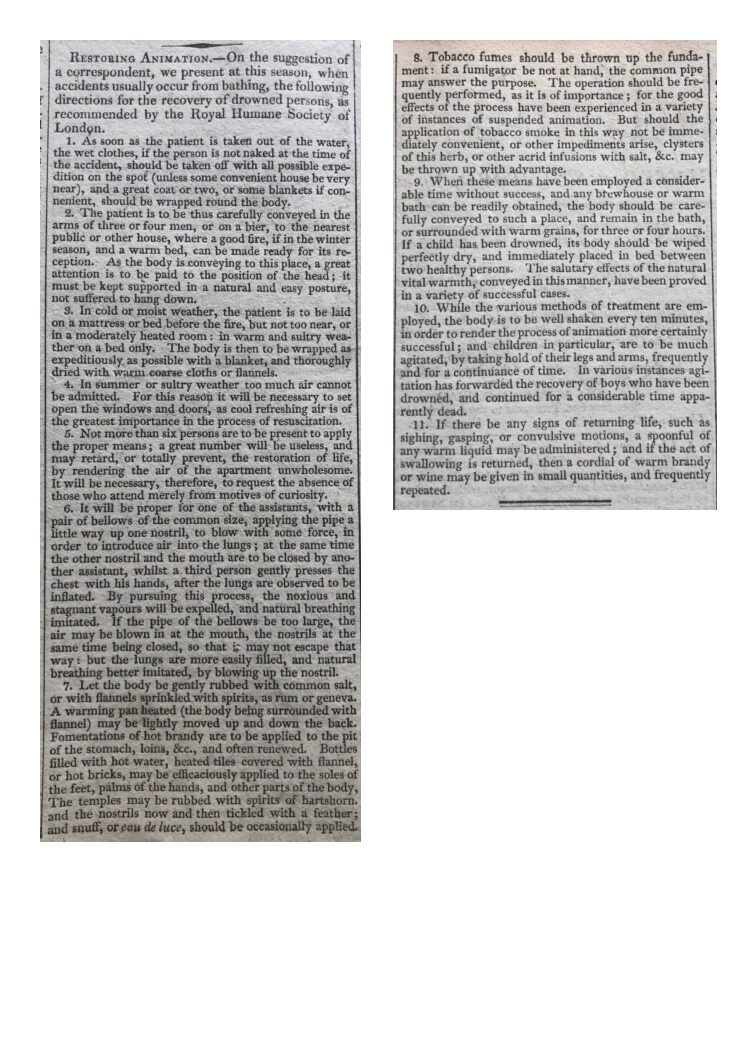
“RESTORING ANIMATION. – On the suggestion of a correspondent, we present at this season, which accidents usually occur from bathing, the following directions for the recovery of drowned persons, as recommended by the Royal Humane Society of London.

  1. As soon as the patient is taken out of the water, the wet clothes, if the person is not naked at the time of the accident, should be taken off with all possible expedition on the spot (unless some convenient house be very near), and a great coat or two, or some blankets if convenient, should be wrapped round the body.
  2. The patient is to be thus carefully conveyed in the arms of three or four men, or on a bier, to the nearest public or other house, where a good fire, if in the winter season, and a warm bed, can be made ready for its reception. As the body is conveying to this place, a great attention is to be paid to the position of the head; it must be kept supported in a natural and easy posture, not suffered to hang down.
  3. In cold or moist weather, the patient is to be laid on a mattress or bed before the fire, but not too near, or in a moderately heated room: in warm and sultry weather on a bed only. The body is then to be wrapped as expeditiously as possible with a blanket, and thoroughly dried with warm coarse cloths or flannels.
  4. In summer or sultry weather too much air cannot be admitted. For this reason it will be necessary to set open the windows and doors, as cool refreshing air is of the greatest importance in the process of resuscitation.
  5. Not more than six persons are to be present to apply the proper means; a great number will be useless, and may retard, or totally prevent, the restoration of life, by rendering the air of the partment unwholesome. It will be necessary, therefore, to request the absence of those who attend merely from motives of curiosity.
  6. It will be proper for one of the attendants, with a pair of bellows of the common size, applying the pipe a little way up one nostril, to blow with some force, in order to introduce air into the lungs; at the same time the other nostril and the mouth are to be closed by another assistant, whilst a third person gently presses the chest with his hands, after the lungs are observed to be inflated. By pursuing this process, the noxious and stagnant vapours will be expelled, and natural breathing imitated. If the pipe of the bellows be too large, the air may be blown in at the mouth, the nostrils at the same time being closed, so that it may not escape that way: but the lungs are more easily filled, and natural breathing better imitated, but blowing up the nostril.
  7. Let the body be gently rubbed with common salt, or with flannels sprinkled with spirits, as rum or geneva. A warming pan heated (the body being surrounded with flannel) may be lightly moved up and down the back. Fomentations of hot brandy are to be applied to the pit of the stomach, loins, &c., and often renewed. Bottles filled with hot water, heated tiles covered with flannel or hot bricks, may be efficaciously applied to the soles of the feet, palms of the hands, and other parts of the body, The temples may be rubbed with spirits of hartshorn. and the nostrils now and then tickled with a feather; and snuff, or eau de luce*, should be occasionally applied.
  8. Tobacco fumes should be thrown up the fundament: if a fumigator be not at hand, the common pipe may answer the purpose. The operation should be frequently performed, as it is of importance; for the good effects of the process have been experienced in a variety of instances of suspended animation. But should the application of tobacco smoke in this way not be immediately convenient, or other impediments arise, clysters of this herb, or other acrid infusions with salt, &c. may be thrown up with advantage.
  9. When these means have been employed a considerable time without success, and any brewhouse or warm bath can be radily obtained, the body should be carefully conveyed to such a place, and remain in the bath, or surrounded with warm grains, for three or four hours. If a child has been drowned, its body should be wiped perfectly dry, and immediately placed in bed between two healthy persons. The salutary effects of the natural vital warmth, conveyed in this manner, have been proved in a variety of successful cases.
  10. While the various methods of treatment are employed, the body is to be well shaken evey ten minutes, in order to render the process of animation more certainly successful; and children in particular, are to be much agitated, by taking hold of their legs and arms, frequently and for a continuance of time. In various instances agitation has forwarded the recovery of boys who have been drowned, and continued for a considerable time apparently dead.
  11. If there be any signs of returning life, such as sighing, gasping, or convulsive motions, a spoonful of any warm liquid may be administered; and if the act of swallowing is returned, then a cordial of warm brandy or wine may be given in small quantities, and frequently repeated.”

The Stamford Mercury, 22nd June, 1821.

*volatile liquid soap, with a strong pungent smell.

Discovery of a Rubens

This painting, produced by Peter Paul Rubens in about 1625 as one of the designs for a series of tapestries, can be seen in the Prado Museum in Madrid, and is now known as “The Triumph of Divine Love“.  The appetite for finding and identifying lost paintings is still with us today in such television programmes as Fake or Fortune and Britain’s Lost Masterpieces.

Singular DISCOVERY of a PICTURE by RUBENS. – A few weeks ago, at the sale of Mr. J.E. Pearson’s effects, at Sheffield, an old picture in which no figure was discernable was knocked down for 1s. 9d. : It was afterwards purchased of the byer for 5s., and the new possessor proceeded to wash it, which caused several of the figures to appear while wet.  This led to a resolution to send it to London to be cleaned, and the old varnish being removed, it turned out to be a very fine old picture.  It was returned to Sheffield, with an offer of 160 guineas for it, and the biddings have since advanced to 350 guineas, at which price, however, it is not to be had.  The picture consists of a fine female figure standing upon a car drawn by a lion ; one child nestles in her bosom, others cling to her robes, others follow her car, while one rides a lion : several other rotund little ones with cherub wings fly about her.  The style of the painting and some other internal evidence have satisfied several eminent connoisseurs that it is a genuine Rubens : and this is confirmed by an old etching of the picture, which is called ‘the triumph of Christianity, by Rubens.’  This prize is in the possession of Mr. Sawyer, wine-merchant, of High-street, Doncaster, where it has been seen by many persons.  The best judges speak of it in very high terms, and the probability is that the biddings for it have by no means reached their maximum. – Doncaster Gaz.”

The Stamford Mercury, 23rd June 1843

As Dog ‘s my Witness

A pug dog was deemed to be an interested witness in this case. He was able to give vocal and physical evidence of the identity of his owner.

COURT of KING’S BENCH, Nov. 30.

Grammont v. Boyton. – This was an action of trover*. The defendant was charged with the conversion# of a pug dog. – Mr. Marryat, who opened the plaintiff’s case, proposed to support it by at least a dozen witnesses. The defendant admitted the taking of the dog, but alleged that he took him in the way of recovery: he confessed that he had found the dog when lost by the plaintiff, but affirmed that he had himself originally lost the dog, and that it was through such loss that the dog had first come into the plaintiff’s possession.

The Lord Chief Justice doubted whether the cause would not be better taken out of Court. The evidence of the dog himself would probably be necessary.

Mr. Gurney, had no objection to that course. The dog, indeed, was his leading witness.

Mr. Marryat begged to deny that fact: the dog was his witness – subpoenaed indeed by him.

Mr. Gurney, in that case, would insist upon cross-examining him.

Mr. Marryat was ready to refer the cause, but the dog would appear most clearly to belong to the plaintiff. In fact, he had already escaped once or twice from the defendant, and had made his way to his rightful owner.

Mr. Comyn took the dog to be an interested witness. It was doubtful how far his evidence would be admissible.

Mr. Gurney was ready to give him a release.

Mr. Marryat – Now you know that you keep him always tied up: if he were released, he would be with us in a moment.

Here the prisoner (the dog) from the lower end of the hall, testified viva voce to the truth of Mr. Marryat’s assertion.

The Lord Chief Justice said that the dog would give his evidence far more collectedly in a prrivate room, before some gentlemen of the bar, Such gentlemen might have more acquaintance with dogs than he (the Lord Chief Justice) could pretend to.

Mr. Gurney was of the same opinion, but his clients demurred.

The Lord Chief Justice was sorry fo it. There was somethjing inconsistent with the decorum of a Court in having such a witness as a dog produced.

Mr. Marryat said that his client was afraid lest the arbitrator might award damages instead of the dog. Nothing could compensate the loss of the animal.

The Lord Chief Justice said that the plaintiff might be ensured: let the arbitrator (to either party) award the dog and nominal damages.

The parties then agreed to refer,

The Stamford Mercury, 7th December, 1821.

*Trover – A law action to recover the value of chattels or goods.

#Conversion – Taking with intent of exercising ownership over a chattel.

Sir Isaac Newton and the Weather Gauge

Did Sir Isaac Newton think he was about to discover a weather gauge to foretell rain? The ram had the answer.

“SIR ISAAC NEWTON AND THE WEATHER GAUGE-The illustrious philosopher was once riding over Salisbury plain, when a boy keeping sheep called to him, “Sir, you had better make haste on, or you will get a wet jacket.” Newton, looking round and and observing neither clouds nor a speck on the horizon, jogged on, taking very little of the rustic’s information. He made but a few miles, when a storm suddenly arising, wetted him to the skin. Surprised at the circumstance, and determined, if possible, to ascertain how an ignorant boy had attained a precision and knowledge in the weather of which the wisest philosophers would be proud, he rode back, as wet as he was. “My lad,” said Newton, “I’ll give thee a guinea if thou wilt tell me how thou canst fortel the weather so truly.” “Will ye, Sir? I will then,” said the boy, scratching his head, and holding out his hand for the guinea. “Now Sir,” having received the money, and pointing to his sheep, “when you see that black ram turn his tail towards the wind, ’tis a sure sign of rain within an hour.” “What!” exclaimed the philosopher, “must I, in order to fortel the weather, stay here and watch which way that black ram turns his tail?” “Yes, Sir.” Off rode Newton, quite satisfied with his discovery, but not much inclined to avail himself of it, or to recommend it to others.”

The Stamford Mercury, 17 October 1828

The Aerial Steam Carriage

The Mercury reports optimistically on a patent for an aerial steam carriage (named ‘Ariel‘), 60 years before the Wright brothers flew at Kitty Hawk, North Carolina.

THE AERIAL STEAM CARRIAGE. – When it was announced some time ago, by the ordinary monthly lists of patents granted, that Mr. Henson had invented a machine capable of conveying dispatches and passengers through the air, the general impression was that some moody and enthusiastic projector was about to exhibit the produce of his day-dreams.  Our readers may, therefore, be somewhat surprised to learn that this is in truth no visionary scheme, but a design of very scientific conception, carefully and perseveringly wrought out.  It would perhaps be too much to affirm (what yet we cannot deny) that the machine in its present state will certainly succeed ; but the least which can be said is, that the inventor has most skilfully removed the difficulties which have hitherto debarred us the possession of the long-coveted faculty of flight, and has made its eventual, perhaps early, attainment a matter of little less than certain.  This device would not have succeeded if the inventor had not effected an extraordinary reduction in the weight of his steam-engine.  Our engineering readers will be somewhat surprised to learn that the engine of 20 horses’ power now in preparation for the aërial carriage weighs with its condenser and requisite water but 600lbs.  To the united effect of these different branches of this important invention must we attribute our present prospect of making our paths in the air.  The area of the sustaining surface will be, we understand, not less than 4500 square feet ; the weight to be sustained, including the carriage and its total burden, is estimated at 3000lbs.  The load is said to be considerably less per square foot than that of many birds.  It may assist the conceptions of our non-mechanical readers to add that the general appearance of the machine is that of a gigantic bird with stationary wings ; that the mechanical principles concerned in its support are strongly exemplified in the case of a kite ; and that its progress is maintained by an application of power like that which propels a steam-boat.  In the operations of nature, particularly in the flight of birds, will be found many striking illustrations of the principles on which the inventor has proceeded. – Whatever may be the immediate issue of the present attempt, we think it is impossible not to award to the inventor the highest credit due to the removal of the great difficulties which have hitherto defeated all similar inventions ; nor do we doubt that, in following out the path he has opened, complete success will eventually be obtained : whether that success will be, as we wish, early and entire, or whether it will be delayed and gradual, depends on the facts as to oblique pneumatic resistance, which have yet to be ascertained.  It is, however, high time to begin to consider in the spirit of careful inquiry and cheerful hope what will be the changes, commercial, social, and political, which the possession of this new-born power will necessarily bring about. – Times.

The Stamford Mercury, April 7th, 1843.

The Search for Magnetic North

Magnetic north was an elusive creature, perhaps because it was, and still is, constantly on the move. In 1828 these men set out to find magnetic north. They only just missed out because three years later it was discovered by another naval man, James Clark Ross.

“Northern Scientific Expedition.–Towards the end of this month (April) Professor Hanstein will set out on his journey to Siberia. He will be accompanied by Lieutenant Due, of the navy ; and at St. Petersburgh they will meet Dr. Erman, from Berlin, who will go with them as naturalist and astronomer. They will proceed from St. Petersburgh to Moscow, Kasan, and Tobolsk, and northwards along the Obi to Beresow, in order to examine the hitherto imperfectly known northernmost branch of the Ural chain, and to observe the temperature of that tract. They will afterwards go from Tobolsk, by way of Tara, Tomsk, Krasnoiarsk, and Nischmei-Udinsk, to Irkoutsk, where they hope to arrive in time to pass the winter. Hence they mean to travel north-east to Jakoutsk, from which the most fatiguing part of the journey will be to Ochotsk, as there are 1014 wersts (676 miles) to go over, in a country entirely uninhabited, in which they must pass perhaps a thousand streams, bivouac in the night, and take provisions for the whole journey. It is calculated that the tour may occupy two years. The grand object of this important expedition is to observe the phenomena of magnetism, and to ascertain, if possible, the situation of the magnetic poles, &c,–Literary Gazette.”

The Stamford Mercury, 9th May, 1828.

Fire Escape invented by John Read

From the stomach pump to the fire escape, Mr. John Read’s inventions knew no bounds. He descended from the various floors of the house causing quite a stir. Other similar creative and amusing fire escape designs were around at this time.

“Great interest was excited on Wednesday afternoon the 30th ult. in Regent-street, by the descent of Mr. Read (the patentee of the stomach pump) from a window nearly 60 feet from the ground, by means of a very simple fire-escape of his invention. The apparatus consists merely of a rope twice the length of the height of the place where it is attached. Above the window of the chamber a ring is fastened to the wall inside the room, a bar crosses the ring perpendicularly, and around this the rope is reflected. Some strong web, which forms a sort of seat, is attached to one end of the rope, and the other being thrown out of the window, the persons escaping from a house on fire lower themselves into the street, by allowing the rope to pass gradually through the hands as they descend. In the same manner children or others may be let down by any one of ordinary courage and coolness, for which purpose a bag is appended to the rope, in which they may be securely enveloped. Mr. Read descended from the various floors of the house with great adroitness, highly to the satisfaction of a great crowd assembled by the novel exhibition.”

The Stamford Mercury, 9th May, 1828.

The Leet of the Manor of Stamford

The Leet of the Manor of Stamford, overseen by the Lord of the Manor, was a force to be reckoned with, from medieval times to more recent times, in Stamford, as hundreds of soon-to-be homeless people would discover. Let’s get everything in perspective : what is more important: a) making hundreds of people, admittedly ‘of the humble kind’, homeless, b) losing £2,000 in rental income, or c) losing 50 votes ? It was a hard choice in 1828.

“At the annual assembly of the Leet of the Manor of Stamford last week, Mr. Torkington, the clerk, stated that the notices given to a few of the persons who had trespassed by building on the waste, would be followed up by active operations in case the owners did not promptly take down the erections ; and that it was intended to give similar notices to all the trespassers, by a dozen or two at a time, and to resort to similar active proceedings in every case of contempt, until all the buildings were removed.–This measure will throw some hundreds of persons out of dwellings ; and, although they are chiefly of a humble kind, will, it is calculated, destroy a rental of about 2000l. a year, and about 50 votes for the borough.”

The Stamford Mercury, 9th May, 1828.

Accidental Shooting

Here’s the story of an accidental shooting that may well have been taken from the pages of any United States newspaper. It is noteworthy because the event occurred in nineteenth century London.

“James Parker, a fine young man, aged 17, met his death last week under the following distressing circumstances. The deceased, the nephew of Mr. James Hayes, paid a visit in company with the family of that gentleman to Mr. Barham, in Cold-harbour-lane, Brixton, on Sunday se’nnight. On their arrival they were introduced into a back parlour, where they had been but a short time, when the deceased said “I perceive you have a gun, Mrs. Barham.” His uncle desired him not to touch it, upon which Mrs. Barham observed that her husband did not allow it to be loaded in the house. Mr. Hayes then examined the piece, and finding no powder in the pan, he snapped it twice under the grate, and gave it to the deceased to put away. At that moment Mrs. Barham said “James, give it to me, I know how to let it off,” and taking the gun, she pointed the muzzle towards the deceased, jocularly saying–“Now mind yourself, James :” at that moment the piece went off, when the whole charge struck the deceased between the eyes, and he instantly sunk in his chair a corpse. A verdict of accidentally shot was returned, and the piece condemned as deodand.”

Stamford Mercury, 9th May, 1828.

The Human Calculator

A human calculator, a savant or just good at arithmetic ? This 10-year-old from the US was undoubtedly a very bright boy indeed.

‘ANOTHER CALCULATING BOY.–A Washington paper gives an account of a boy in that city, named Edward Ord, only ten years of age, who appears to be not only a prodigy in calculation, but in ready wit. A number of gentlemen who visited him for the purpose of proving his talent, asked him, “If I give away one-third, one-fourth, and one-fifth of a bushel#, what shall I have left of two bushels ?” After a few moments’ consideration, he answered correctly, “43-60ths of a bushel.” He was then asked, “If a pair of boots costs six dollars, what will a hat cost ?” He answered readily, “Different prices ;” and immediately proposed a similar question–“If a bushel of coals costs 6 1/2 cents., what will a cord† of wood come to ?”–“I don’t know,” said the gentleman. “It will come to ashes,” said the boy–He was then asked. “If 7-10ths of a yard of kerseymere* cost two dollars 25 cents., what will a yard and a quarter cost ?” and, after a short pause, answered, with his usual precision, “Four dollars, two cents., and 12-28ths of a cent.”‘

Stamford Mercury, 21 November, 1828.

#A US measure of capacity equivalent to 35.2 litres, used for dry goods.

*A fine woollen cloth, with a twill weave.

†128 cubic feet.